Clinical judgment for each animal
The veterinarian looks at symptoms, history and current condition and decides whether a treatment approach applies.
MARU / TREATMENT IN DEPTH
Telomere · Chamber · Quantum-related treatment approaches.
We look at how treatment for companion animals is reviewed, and at the scientific background behind it.
THE WHOLE PICTURE
Treatment of companion animals is at the heart of Maru. We link test information to clinical care that looks at symptoms and history, and review together whether a treatment approach applies and how the animal progresses afterward.
The veterinarian looks at symptoms, history and current condition and decides whether a treatment approach applies.
We look at what information the specialized lab’s analysis provides and how far it can be interpreted.
We record changes in activity, daily life and clinical information along with test results, and look at each type of record separately.
01 / TELOMERE
Telomeres are repetitive DNA sequences at the ends of chromosomes. They are involved in protecting and maintaining chromosome ends, and telomerase is the enzyme that synthesizes telomere DNA.
it is the study of the structure that protects chromosome ends. An individual animal’s condition is not judged by a single sentence such as “longer means healthier.”
Maru’s existing materials present a companion-animal telomere research lab and anti-aging care. The purpose of a treatment approach and how it is actually applied are addressed together with clinical judgment for each animal.
The official PetAge360 description presents telomere length analysis of an oral sample and a report. Testing is a process of obtaining information; it does not mean that the test itself is a treatment that lengthens telomeres.
Testing company’s description →02 / CHAMBER
The chamber is one pillar of the equipment and space that Maru presents as a main treatment. Existing materials list a “CR room chamber” under the telomere research lab.
The starting point is the manufacturer and model, and the physical conditions it applies. We do not assume a specific method, such as hyperbaric oxygen or electromagnetic fields, from the name ‘chamber’ alone.
The target condition, the purpose of use and the veterinarian’s criteria should be looked at separately from the equipment description.
Recording the conditions and process of use, observations of the animal’s response and any concurrent care is the basis for understanding the treatment process.
We look at the condition before and after the equipment is used, symptoms and function, and clinical records together. We do not conclude that the equipment alone had an effect based only on the order of events.
The principles and relevant research differ depending on the exact type of equipment. Studies of other types of chambers are not used in place of evidence for this equipment’s treatment effects.
03 / QUANTUM-RELATED APPROACH
Maru takes Director Son Hwa-seop’s wave- and quantum-related animal treatment technology as a main direction of its clinical care. The existing brochure contains explanations of the glomus, reversibly damaged cells and energy, along with cases of animals with nerve injuries.
We look at how the proposed principle connects with the way the actual equipment works.
We look at which animals, conditions and settings were studied, and whether there were control groups and measured results.
We look at how each animal’s care, concurrent treatments and changes in function and symptoms were recorded.
The existence of quantum mechanics as a general theory and the effect of a specific device in treating animals are separate matters. We present Maru’s technology descriptions, animal cases and external research separately, according to what each one actually supports.
View Maru animal cases in detail →SCIENCE BEHIND THE QUESTION
Cell principles, observational animal studies and experimental treatment research.
Let’s look at what the evidence does — and does not — say.
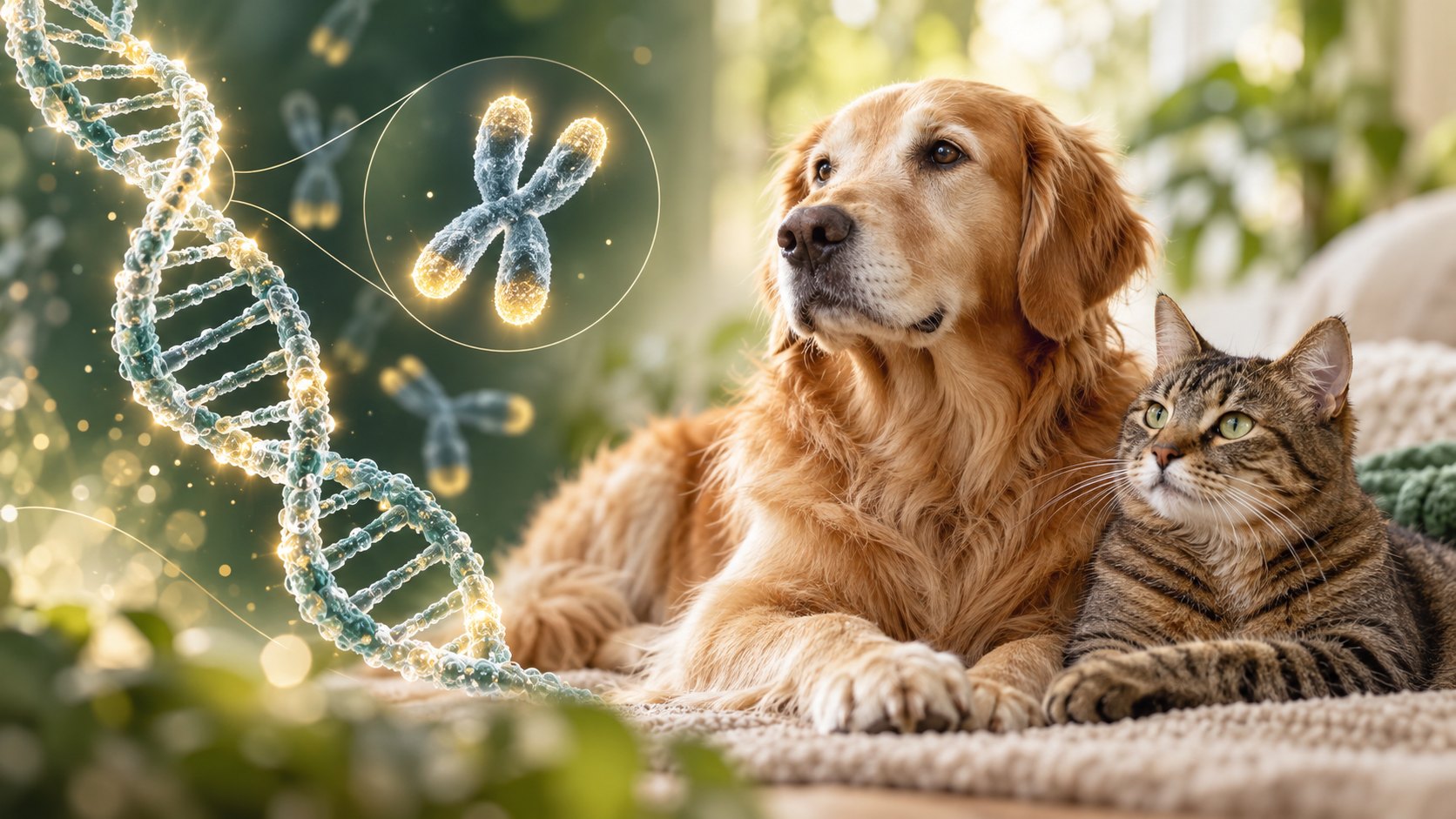
Diagram explaining the principle · not actual measurements or a before-and-after treatment comparison
Telomeres are repetitive DNA sequences at the ends of chromosomes, and telomerase is the enzyme that synthesizes them. The discovery of this protection and maintenance mechanism was the subject of the 2009 Nobel Prize in Physiology or Medicine.
It is a basic principle for understanding cells and chromosomes. The Nobel Prize does not certify the effectiveness of any particular hospital treatment or device.
A 2012 study reported an association between telomere length in blood mononuclear cells and average breed lifespan across 15 dog breeds. This is one reason telomeres are examined in animal aging research.
This study looks at associations at the breed level. It does not calculate an individual animal’s remaining lifespan or prove that treatment extended lifespan, and blood-study results cannot be equated with the performance of an oral-sample test product.
A 2012 study delivered the telomerase gene to adult and aged mice using an AAV9 vector. Under the study conditions, improvements in some health markers and an increase in median lifespan were reported.
This is a specific gene therapy experiment in mice. It did not use chamber or wave equipment and cannot be taken as evidence that the same results occur in dogs, cats or Maru’s treatments.
The connection Maru aims for is research principles → test results → clinical judgment for each animal → progress records. We explain the scientific background and real-world results separately.
DISEASE CATEGORIES
We have carried over every item from the newly received material and briefly explained what each name means.
The source material mixes human disease names with different medical classifications. It is not a list of conditions Maru treats in animals, nor a list of conditions for which treatment effects have been confirmed.
The category title is as given in the source material.
The category title is as given in the source material; not every item is an autoimmune disease.
Source of disease names: newly received material. The original photo has been kept, and its content is shown here as text. The terms ‘Welson’ and ‘ankylosing myelitis’ need to be checked against the source material.
References for the explanations: US National Institute of Mental Health: health topics · Lupus · Crohn’s disease · Rheumatoid arthritis · Wilson’s disease
FROM ANALYSIS TO FOLLOW-UP
We put together symptoms, when the changes started, previous tests and treatments, and current medications.
We understand the test’s purpose, the items measured and the scope of interpretation, and review which analyses are needed.
The direction of treatment is reviewed based on the animal’s condition and clinical information, not on a single test value.
We distinguish what was applied, when and how, and whether other treatments or medications were involved.
We review progress in activity, symptoms and function together with test information, and decide whether follow-up care is needed.
This is the flow of explanation and recording that Maru aims for. Each animal’s treatment plan depends on clinical judgment.
QUESTIONS & ANSWERS
No. Testing is a process of measuring information such as length. The purpose of a treatment approach and whether it applies must be explained and decided separately.
No. The mouse study on this page was an experiment in which a gene was delivered using an AAV9 vector. It was not an experiment using a chamber or wave equipment.
We do not judge by test values alone. Measurement conditions and variability, the animal’s symptoms, function and clinical information, and concurrent treatments must all be considered together.
They should be understood as the progress recorded for that particular animal. Individual cases alone cannot guarantee recovery for every animal or the sole effect of any specific device.
Previous clinical and test results, current medications, the date the changes began, and photos or videos of movement and behavior will help with the explanation.